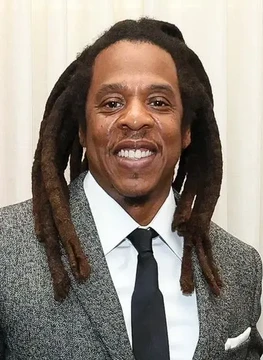
50 Cent
Nine bullets, one album, and a whole industry that had to make room.

Curtis James Jackson III, known to the world as 50 Cent, is a Queens-born rapper, producer, and entrepreneur whose meteoric rise in the early 2000s made him one of the most recognizable figures in hip-hop. His story—surviving a drive-by shooting, signing with Dr. Dre's Aftermath label, and detonating the cultural phenomenon that was his debut album—placed him squarely in the same competitive orbit as Jay-Z, the Brooklyn-born mogul who dominated the industry's power structures through Roc-A-Fella and later Def Jam. In the Jay-Z universe, 50 Cent occupies the role of the great rival-adjacent force: not a direct label mate, not a long-time friend, but a fellow Queens-and-Brooklyn product who commanded his own empire, his own crew (G-Unit), and his own narrative of survival. Their intersection is defined less by handshakes and more by the gravitational pull of competing for the same cultural crown in the mid-2000s, punctuated by the G-Unit versus Bad Boy feud that shook the industry.
- Real name
- Curtis James Jackson III
- Hometown
- Queens, New York
- Debut studio album
- Get Rich or Die Tryin' (2003)
- Primary label
- G-Unit Records / Aftermath Entertainment
- Signature group
- G-Unit
- Defining survival event
- Shot nine times in 2000, survived
- Industry era peak
- Early-to-mid 2000s
Lore & Background
The story of 50 Cent is, at its core, a story about refusal. In 2000, a drive-by shooting in Queens left him with nine bullet wounds, a shattered jaw, and a face that would never fully heal. Most rappers in that position would have faded into obscurity. Instead, he spent his recovery writing, and when Dr. Dre heard the tapes, he saw something raw and unbreakable. The result was an album that didn't just chart—it colonized the cultural conversation, selling in multiples of millions and turning a Queens kid with a scarred cheekbone into a global icon almost overnight. That success created a gravitational field. G-Unit became its own label, its own brand, its own ecosystem of rappers (Young Buck, Lloyd Banks, Tony Yayo) who carried the same street-cred mythology. In the Jay-Z universe, this meant a second power center in New York that didn't answer to Roc-A-Fella or Def Jam. The two empires existed in the same city, the same industry, the same radio rotation, and the tension was inevitable. The G-Unit versus Bad Boy feud of the mid-2000s was the most visible flashpoint. It was less a personal vendetta and more a territorial assertion: two Queens-and-Brooklyn crews, two labels, two narratives of who owned the streets and the airwaves. It played out in diss tracks, radio interviews, and the broader media circus that hip-hop feuds always attract. What made it resonate was that both sides were genuine—both had real fans, real crews, real stakes. It wasn't manufactured. It was two men who had clawed their way up from the same boroughs, now pulling in opposite directions.
In Their Own Story
The studio in Queens smelled like stale Red Bull and warm tape machines. It was 2004, and the city was still processing what had happened the year before—how a kid with a scarred face had walked into a room full of industry executives and made them feel small. Outside, the November wind off the East River carried the sound of a distant siren. Inside, a producer flipped a beat on the turntable, something with a snare that hit like a knuckle on a table. The rapper leaned back in the chair, jaw still a little stiff from the old injuries, and let the beat breathe. He wasn't performing for anyone right now. He was just a man in a room, remembering what it felt like to be on the ground with blood in his mouth, and then remembering what it felt like to stand up. The beat looped. He closed his eyes. Somewhere across the river, in a different building, a different man was doing the same thing—looping a beat, closing his eyes, building an empire one bar at a time. Two Queens kids. Two scars. One city that couldn't decide which one to crown.
Reader's Guide
The most defining moment in the 50 Cent–Jay-Z axis is not a handshake but a collision: the G-Unit versus Bad Boy feud that split New York hip-hop down the middle in the mid-2000s. Two crews, two labels, two narratives of street legitimacy, pulling against each other in a way that made the entire industry hold its breath. Before the feud, the relationship was one of parallel ascent. Both men were Queens-and-Brooklyn products who had clawed their way up through independent hustle before major labels noticed. 50 Cent's 2003 debut detonated the cultural landscape at the exact moment Jay-Z was consolidating his position as the industry's most powerful figure. They occupied the same radio slots, the same magazine covers, the same conversation about who really ran New York hip-hop. The feud itself was less about personal animus and more about territorial pride. G-Unit asserted that their street credibility wasn't something a label machine could manufacture. Bad Boy responded in kind. The diss tracks, the radio wars, the media circus—it all served a deeper function: proving to their respective fanbases that they still owned the block. What makes this pairing matter to the culture is that it represents the generational handoff and the territorial politics that define New York hip-hop. Neither man needed the other. Both needed the competition. The tension between them is the tension between two valid claims on the same city's soul, and that's a story that never really ends.
Did You Know?
- 50 Cent was shot nine times in a 2000 drive-by in Queens and survived with a permanently scarred jaw, a detail that became central to his public mythology and album narrative.
- His debut album 'Get Rich or Die Tryin'' (2003) was distributed through Dr. Dre's Aftermath Entertainment, making him a figure in the G-Family orbit rather than the Roc-A-Fella/Def Jam orbit that Jay-Z controlled.
- G-Unit Records functioned as both a rap group and an independent label, giving 50 Cent a structural parallel to Jay-Z's own label-building philosophy, just under a different corporate umbrella.
- The G-Unit versus Bad Boy feud of the mid-2000s was notable in hip-hop history for being a genuine territorial dispute between two New York crews rather than a manufactured publicity cycle, lending it a weight that fans
More in Artists & Collaborators
Elsewhere in the Jay-Z universe
Spotted an error? Know more?
This is a living reference — every entry is fact-audited, and reader corrections feed straight into our audit queue. Suggest an edit · See this site's audit record